Why Your Website Feels Slow Even When Your Internet Is Fast

September 19, 2026 · 8 min read
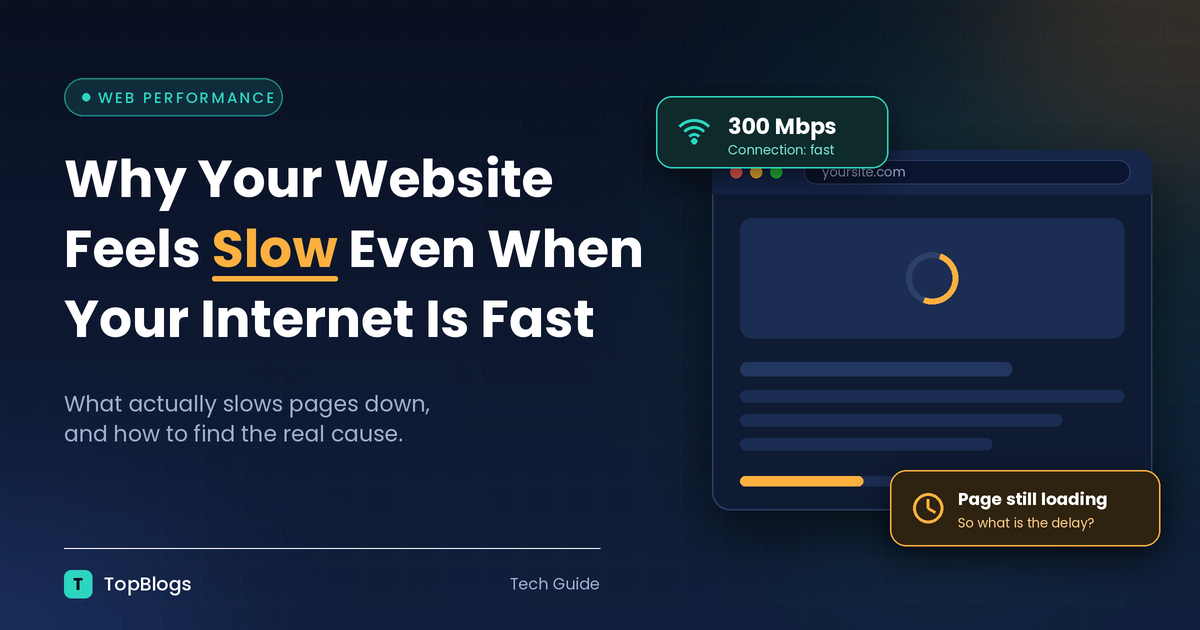
You're on a good connection. The speed test says 300 Mbps, maybe more. And yet a website opens to a blank white screen, sits there for a couple of seconds, and when it finally shows up, the menu ignores your first tap.
It's tempting to blame your internet provider. For a single slow website, that's often the wrong place to start.
Connection speed is only one piece of what makes a page feel fast, and often not the biggest one. Below are the other pieces, plus a few real cases where companies tracked down their own slow spots and fixed them.
Bandwidth and speed aren't the same thing
The "300 Mbps" on your plan is bandwidth, basically the width of the pipe. A wide pipe is great for movies and big downloads. A web page is a different animal. It's made of lots of small requests, and each one has to travel to a server and back before anything appears. That round trip is called latency.
Mike Belshe tested this back in 2010, when he was at Google. Going from 5 Mbps to 10 Mbps improved page load time by only about 5%. But cutting 20 milliseconds from the round trip trimmed it by 7 to 15%. Cloudflare later pointed to a study built on US broadband data, and the point where extra bandwidth stops helping had moved up to around 20 Mbps. The shape of the curve was the same, though.
There is a wrinkle, though. A 2025 paper on arXiv reached a somewhat different conclusion: with today's heavier pages, both bandwidth and latency still help at a steady rate. So I wouldn't call bandwidth pointless. It's just a poor first move when one particular site feels sluggish and the rest of the web is fine.
When the server takes its time
Before your browser can show anything, it needs the first chunk of the page. How long that takes is called Time to First Byte, or TTFB. WP Engine, for example, uses under 200 milliseconds as its benchmark for great and 200 to 500 as acceptable, though what counts as good really depends on the kind of site. Slower than that usually means the server is building the page from scratch for every visitor, waiting on database queries, or has no caching at all. WordPress sites with a long plugin list run into this a lot, since each plugin can add work before the first byte goes out.
Everything after it depends on that first wait. With an 800 millisecond server response, the browser has already used up a big slice of a 2.5 second Largest Contentful Paint budget before it starts on the rest of the page. DebugBear shows a real page where the first byte alone took 3.1 seconds of a 5.7 second load.
There's a common mix-up here, though. A fast TTFB doesn't mean a fast page. A page can start quickly and still feel slow if JavaScript blocks it, the images are oversized, or the main image is lazy-loaded when it shouldn't be.
Pages have gotten heavy
HTTP Archive's 2025 Web Almanac says the median mobile home page weighed about 845 KB in July 2015. A decade later it was well over 2 MB. That's nearly triple, across years when connections got much faster.
JavaScript is a big part of that. The same report puts the median mobile home page at around 632 KB of it. And JavaScript costs more than its size suggests. An image gets downloaded and drawn. A script gets downloaded, parsed, compiled and then run, and your phone's processor does all of that, not your router. It's why a site can feel fine on a new laptop and clumsy on a cheap phone, over the same Wi-Fi.
Third-party code piles on top. According to the Almanac's third-party chapter, more than nine in ten pages load at least one third-party resource, with ads, analytics and CDNs the most common. Chat widgets, A/B testing tools and cookie banners are in the mix too. A single third-party script may not seem expensive. A page carrying dozens of them is a different story. If you can't drop them, load them after the page is usable.
A bus booking site with a slow date picker
redBus is an online bus ticketing platform in India. On its search page you can change the travel date to filter fares, and that small interaction lagged.
When the team looked closer, per Google's web.dev case study, they found two causes. As people scrolled, more fares were loaded from the API, and the scroll listener kept the browser's main thread busy. Separately, typing into an input field triggered an expensive function that redrew more of the screen than it needed to.
The fix was to keep each input's state local and only sync it when the user left the field. Interaction to Next Paint on the page improved by 72%, and redBus reported about 7% more sales. The connection was never the issue. The page just couldn't keep up with a finger.
Same page, faster page
Vodafone Italy wanted proof that speed work would pay off, so they ran an A/B test on a landing page, as documented on web.dev. The two versions were visually and functionally equivalent. The difference was that one had been tuned for Core Web Vitals, partly by moving a widget's rendering from the browser to the server, cutting render-blocking JavaScript, and optimizing images.
The optimized version had a 31% improvement in Largest Contentful Paint and generated 8% more sales in the experiment. web.dev's also reports that Rakuten 24, after its own Core Web Vitals work, saw conversion rate rise by about 33% in an A/B test.
Results like these come from specific companies with specific pages, so don't expect the same numbers on your own site. The direction is the useful part.
The layout that kept jumping
If you run ads on a blog, this one's for you.
iCook had a visual stability problem around its ads, the kind where the page shifts as things load in. According to web.dev's write-up on the business impact of Core Web Vitals, they reserved fixed-size slots for the ad units ahead of time so the layout stopped moving, and they cleaned up how the ad scripts loaded. Their layout shift score improved by 15%, and ad revenue went up about 10%.
You've probably felt the other side of this. You go to tap a link, the page shifts, and you hit an ad by accident. Nobody wants that click, including the advertiser.
Why it can feel slow after it has loaded
Google scores pages on three things, called Core Web Vitals. Largest Contentful Paint is about how fast the main content shows up, and good means within 2.5 seconds. Interaction to Next Paint is about how quickly the page reacts when you tap or click, and good means 200 milliseconds or less. Cumulative Layout Shift is about how much the page jumps around while loading, and good means 0.1 or less.
INP replaced the older First Input Delay metric in March 2024, and it's tougher, because it looks at your interactions across the whole visit rather than only the first click. Scores are judged on real visitors at the 75th percentile, so a quick test on your own fast laptop doesn't tell you much.
Plenty of sites miss. In the 2025 Web Almanac, only 48% of mobile websites passed all three, and loading was the weakest of the bunch.
Small gains seem to matter too. Deloitte's research for Google, called Milliseconds Make Millions, covered 37 brands and found that a 0.1 second improvement in mobile speed was associated with an 8.4% rise in retail conversions. That's a correlation across many sites, not a promise that any single change will do the same.
Don't rule out your own network
The site isn't always the problem. Interference, a crowded router or a congested ISP route can slow pages down even when the server is perfectly healthy.
An easy check is to open a few unrelated websites. If they're all slow, look at your own connection. Then try the same page on wired Ethernet, Wi-Fi and mobile data. If one site is slow everywhere and the others are fine, it's the site.
Finding the actual cause
Start by running the page through PageSpeed Insights, and read the real-user data before the lab score. Then check TTFB. If it's slow, look at hosting, caching and plugins before anything else.
Next, find your LCP element, which is usually a hero image, and make sure it's the right size, compressed and not lazy-loaded. Make a list of your third-party scripts and remove whatever you can't justify. Give ad and image spaces a fixed size so the page doesn't jump. And test on a real phone, not just your desktop.
If I had to pick one place to begin, it would be the server response. A slow first byte holds up everything that comes after it, so weak caching or a struggling host can undo good front-end work before the browser even gets started.
Sources and further reading
HTTP Archive: The 2025 Web Almanac (Page Weight, Performance, and Third Parties chapters)
Google web.dev: redBus INP case study
Google web.dev: Vodafone case study
Google web.dev: The business impact of Core Web Vitals
Deloitte and Google: Milliseconds Make Millions
Mike Belshe: More Bandwidth Doesn't Matter (Much)
Cloudflare: Making home Internet faster has little to do with speed
Frequently asked questions
More to read

How to Become a Software Developer Without a Degree
Thinking about coding your way into tech without a CS degree? Here's what actually gets you hired in 2026: the right first language, projects that prove real skill, honest timelines, and what the job really pays.
$ published Sep 18, 2026 · 7 min read · #webdev #careers
Hanzla Baig
What Is Digital Marketing? A Complete Beginner's Guide
Digital marketing is basically about getting people to notice and buy things online, rather than relying on TV ads, newspapers, or billboards. But there’s more to it than that. Here’s what digital marketing actually includes and where you can start if you’re completely new to it.
$ published Sep 17, 2026 · 9 min read · #content-marketing #search-rankings
 Malik Asghar